Auckland gets about 1,200mm of rain per year, high humidity in summer, strong UV, and salt air along the coast. Your deck needs to handle all of that.
We've built decks across Auckland using every common material. Here's an honest comparison based on what we see performing well (and what doesn't) over 5, 10, and 15+ years.
Kwila (Merbau)
Kwila is the most popular premium decking timber in Auckland. It's a tropical hardwood from Southeast Asia with natural oils that resist rot and insect attack.
Cost: $180 to $250 per sqm installed (materials and labour). This is for decking boards only, not the subframe.
Pros:
- Dense and durable. Life expectancy of 20-25+ years with maintenance.
- Rich reddish-brown colour that looks premium from day one.
- Naturally resistant to rot and insects without chemical treatment.
- Weathers to a silver-grey if left unfinished (some people prefer this).
Cons:
- Tannin bleed. New kwila leaches red-brown stain for the first few months, especially in rain. This stains concrete paths, driveways, and cladding if not managed.
- Requires oiling every 12 to 18 months to maintain its colour. Without oil, it goes grey.
- Hard timber means harder to work with (pre-drilling required for every screw).
- Supply has become more variable in recent years. Some lower-grade kwila is entering the NZ market, so buy from a reputable merchant.
Treated Pine (H3.2 or H4)
Treated pine is the most affordable decking option in New Zealand. It's radiata pine pressure-treated with preservatives to resist rot and fungi.
Cost: $90 to $150 per sqm installed (materials and labour).
Pros:
- Lowest cost. Roughly half the price of kwila.
- Widely available from every timber merchant in Auckland.
- Easy to work with. Cuts, screws, and shapes without issue.
- Takes stain and paint well.
Cons:
- Shorter lifespan. Expect 12-15 years for H3.2, longer for H4 treatment.
- Splits, cracks, and warps more than hardwood, especially in Auckland's sun.
- Needs staining or painting every 1-2 years to prevent greying and deterioration.
- The treatment chemicals (copper-based) give it a green tint initially. This fades over time.
- Splinters more than hardwood, especially as it ages.
Our take: Treated pine works fine for budget-conscious projects or decks that will be covered (under a pergola, for example). For exposed decks, we usually recommend stepping up to kwila or composite.
Composite Decking
Composite decking is made from a mix of wood fibre and plastic (typically polypropylene or polyethylene). Major brands available in NZ include TimberTech, Trex, and Futurewood.
Cost: $200 to $350 per sqm installed, depending on brand and profile. The boards are more expensive than timber, but the subframe is still timber or steel.
Pros:
- Almost zero maintenance. No oiling, no staining, no painting. Wash it once a year.
- Won't rot, split, or warp.
- No splinters. Good for families with young kids.
- Consistent colour that doesn't fade as much as timber (higher-end products).
- Manufacturer warranties of 20-25 years on many products.
Cons:
- Higher upfront cost than timber.
- Gets hot underfoot in direct summer sun. Auckland's nor'west days can make an exposed composite deck uncomfortable to walk on barefoot.
- Doesn't look exactly like real timber. It's close, but most people can tell the difference.
- Cheaper composite products can look plasticky and fade unevenly.
- Can't be sanded or refinished. If it gets damaged, you replace the board.
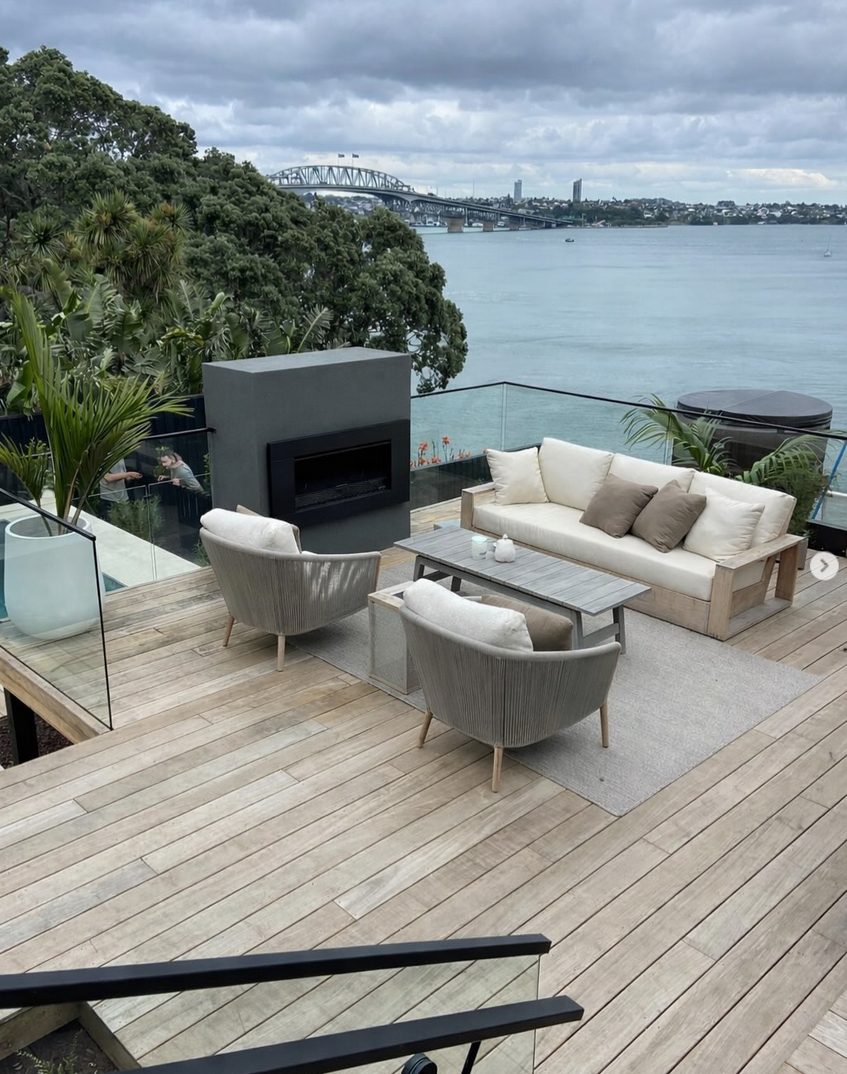
Our take: Composite makes sense if you want a low-maintenance deck and don't mind the upfront cost. For harbour-view decks and premium outdoor living areas, we often use composite because the homeowner doesn't want to spend weekends oiling the deck.
Vitex
Vitex is a Pacific hardwood similar to kwila but lighter in colour. It's becoming less common in the NZ market due to supply issues, but it's worth mentioning.
Cost: $200 to $280 per sqm installed.
It performs similarly to kwila but with less tannin bleed. If you can source it, it's a solid option. Check availability with your builder before committing to it in your plans.
Auckland's Climate Challenges
Whatever material you choose, Auckland's climate puts specific demands on your deck:
UV exposure. Auckland gets strong UV, especially November through March. All timber decks will grey without UV-protective oil or stain. Composite resists UV better, but cheap products still fade.
Humidity and moisture. Auckland's humidity (often 70-90%) means timber doesn't fully dry out between rain events. This accelerates rot in untreated or poorly maintained timber. Proper airflow under the deck is critical. Build the subframe with adequate clearance from the ground and ensure drainage underneath.
Salt air. Within a few kilometres of the coast, salt air accelerates corrosion of metal fixings. Use stainless steel screws and brackets on coastal decks. Galvanised fixings corrode faster than you'd expect near the Waitemata.
Council Rules for Decks
Not all decks need a building consent, but many do. The key threshold is height.
- Under 1.5m above ground: No building consent required (under Schedule 1 exemptions), as long as the deck doesn't have a roof and isn't attached to the house in a way that affects the building structure.
- Over 1.5m above ground: Building consent required. The deck needs to be designed and inspected like any other structure.
- Covered decks: If you add a roof or pergola over the deck, consent requirements change. A solid roof makes the deck part of the building's gross floor area, which affects site coverage calculations.
Also check your property's boundary setback rules. Auckland's Unitary Plan sets minimum distances between structures (including decks) and property boundaries. In most residential zones, the side yard setback is 1 metre.
Cost Per Square Metre Summary
- Treated pine: $90 to $150/sqm installed
- Kwila: $180 to $250/sqm installed
- Vitex: $200 to $280/sqm installed
- Composite: $200 to $350/sqm installed
These are for decking boards and labour only. Add the subframe ($50-$100/sqm), balustrades if needed ($150-$300 per linear metre), and any site prep or foundation work.
A typical 30 sqm deck with kwila boards, timber subframe, and a simple balustrade on one side runs $8,000 to $14,000 all up. A premium composite deck of the same size with stainless steel wire balustrade will be $12,000 to $18,000.
What We Recommend
There's no single "best" material. It depends on your budget, how much maintenance you're willing to do, and what matters to you. If you want the look and feel of real timber and don't mind annual oiling, go with kwila. If you want zero maintenance, go composite. If you're on a budget, treated pine with a good stain will serve you well for a decade.
Whatever you choose, the subframe matters as much as the boards. A cheap deck on a well-built subframe will outlast an expensive deck on a poorly built one.
Ready for a New Deck?
We build decks across Auckland using kwila, pine, and composite. Talk to us about your outdoor space.
Get a Free Quote